Do Dolphins Bite Swimmers On A Dolphin Swim Near Perth?
Do dolphins bite swimmers? What the WA rules, the operators and the Rockingham swim's own format actually say about contact, distance and swimmer safety.
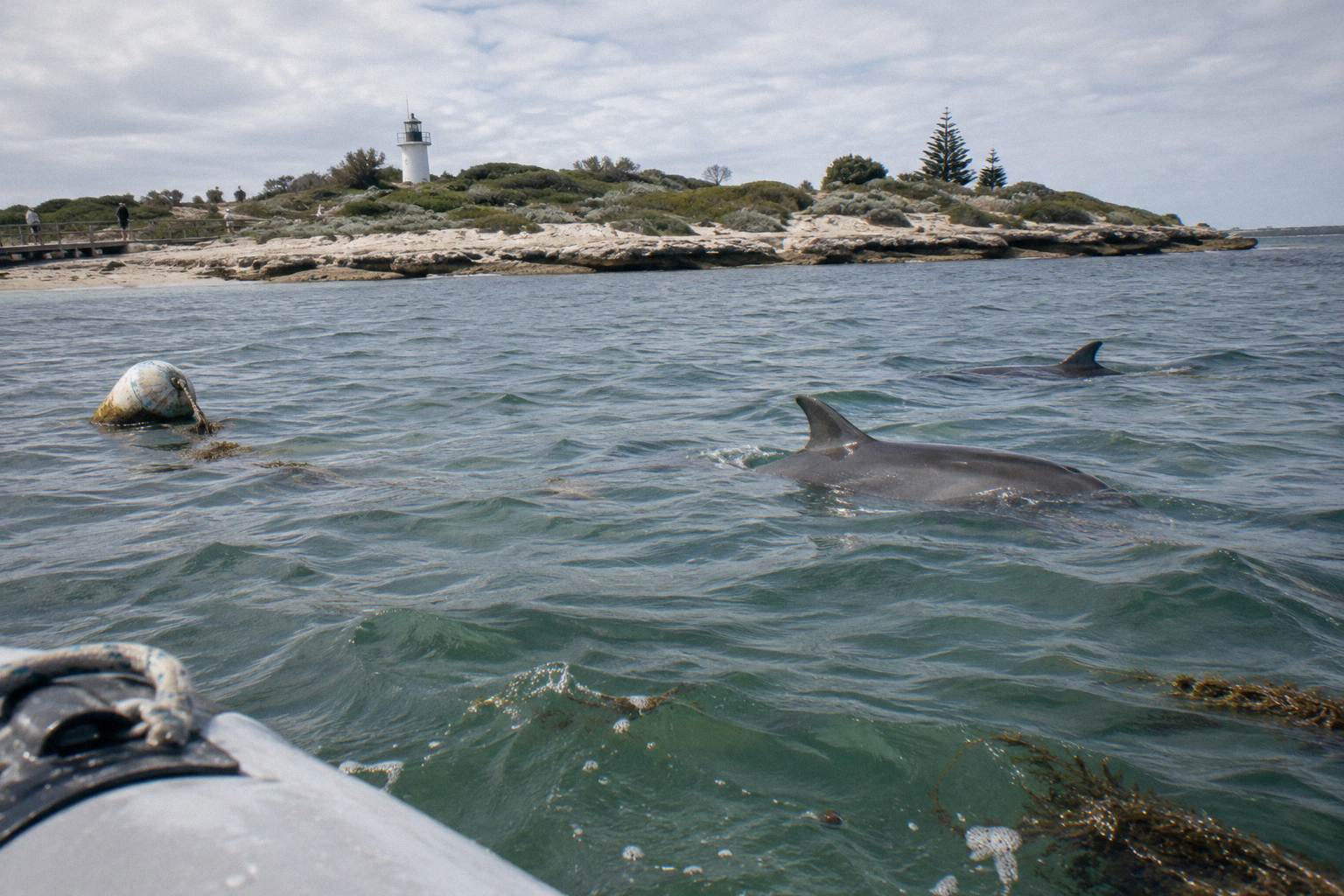
In short: No operator page, no booking page and no WA regulation statement on any operator or official page mentions dolphin bites at all, so nothing can be said about how likely or unlikely a bite is. What is stated is different and more useful: touching any marine fauna carries a AUD 10,000 fine in Western Australia, swim groups are led by a guide, and swimmers must move away if a dolphin closes the distance. The worry and the rules point the same way, keep hands off and let the dolphins choose the moment.
Start with the answer, which is that it is not stated. For the deeper background on where in WA you can get in the water, see where in WA you can swim with dolphins.
Do Dolphins Bite Swimmers?
On the bite question itself, nothing in the operator pages, the booking pages or the WA regulations says anything either way, and no injury or incident figures exist on any operator or official page, so no claim about biting can be made here. What the operators and official pages do give you is a set of rules that keep a swim structured: wild dolphins are prescribed fauna in Western Australia, touching or attempting to touch any marine fauna carries a AUD 10,000 fine, and a swimmer must move away as soon as reasonably possible if a dolphin comes closer than the 50 m separation distance. On a guided swim the format adds its own structure, small groups, a guide, hands on the guide's belt, staying at the surface. None of that is a promise about dolphin behaviour, and none of it needs to be, because the design of the day does the work.
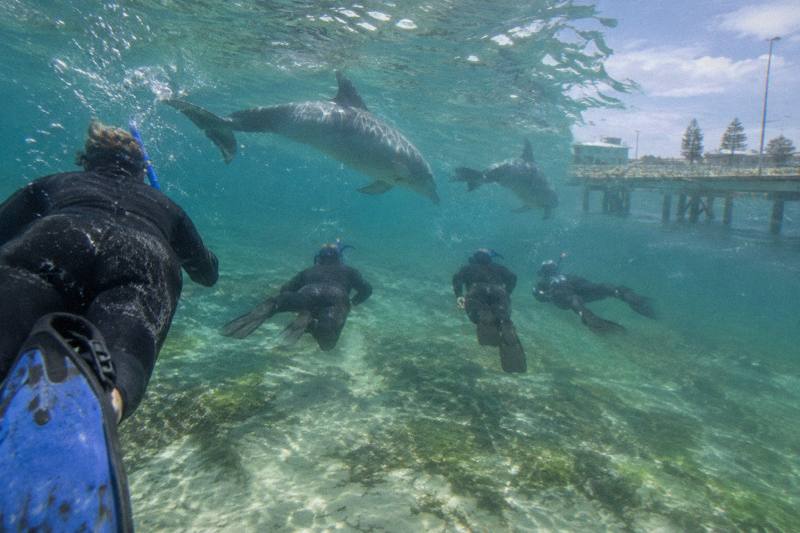
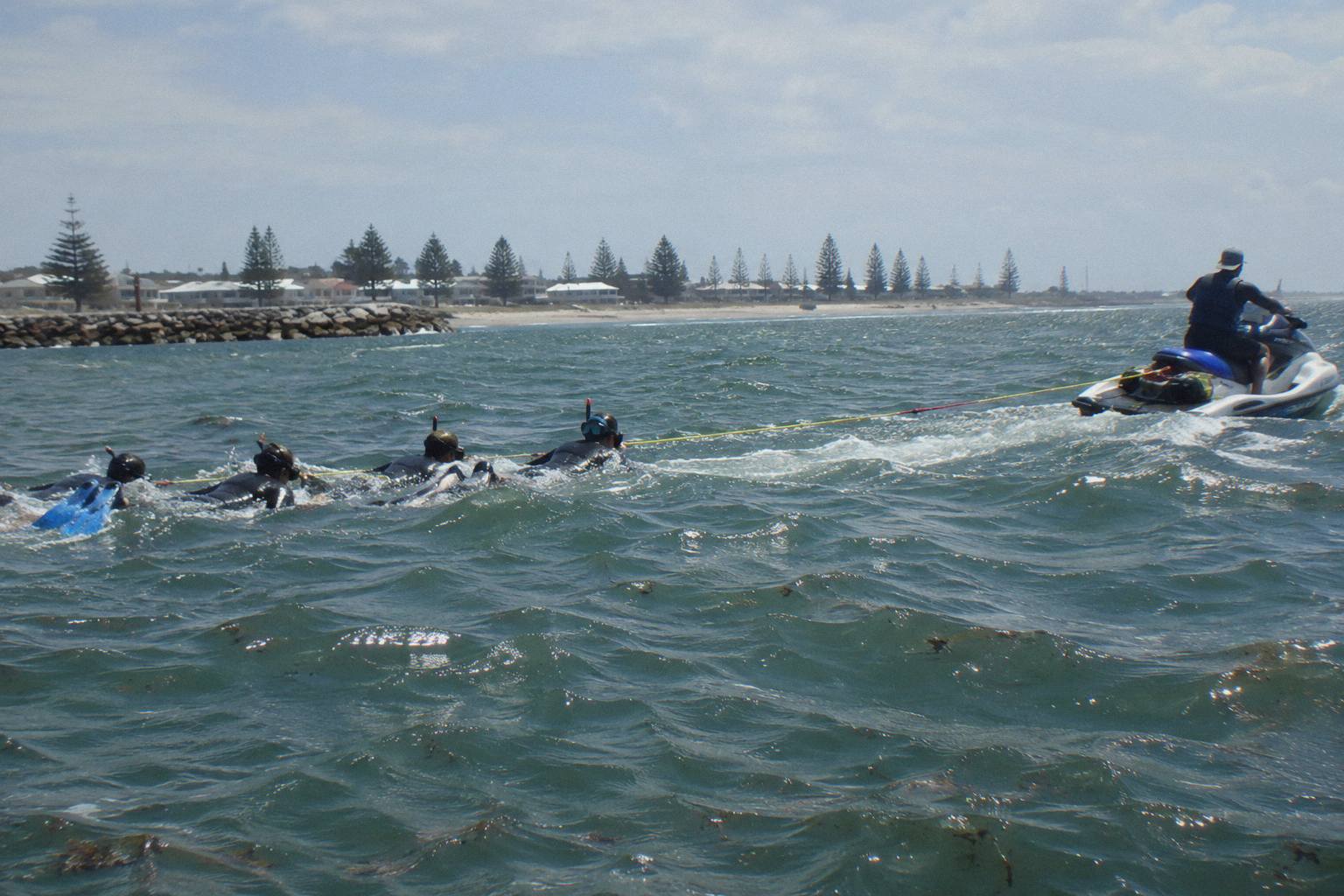
That is the shape of the answer. The pages that describe these swims talk about how contact is prevented, not about what a dolphin might do. Perth Wildlife Encounters, the operator of the Rockingham Wild Dolphin Swim, states its rules plainly: no touching and no feeding. Its format puts each swimmer in a group of up to 7 behind a guide on an aqua scooter, holding the guide's belt, staying at the surface while a second guide on a solo scooter works around the group. The swimmer's hands are occupied and the dolphin's space is respected by design.
If you are weighing this worry against getting in the water at all, the comparison worth reading is a wild dolphin swim versus a dolphin watching cruise, because staying dry on a vessel is the other legitimate way to spend the morning.
| Source | What it says about bites | What it says about contact |
|---|---|---|
| Perth Wildlife Encounters, operator of the Rockingham swim | Not stated | no touching, no feeding; groups of up to 7 led by a guide on an aqua scooter |
| Dolphin Discovery Centre, operator of the Bunbury swim | Not stated | guided swim in Koombana Bay; swimmers must be independent, confident swimmers |
| WA Biodiversity Conservation Regulations 2018 | Not stated | touching or attempting to touch marine fauna carries a AUD 10,000 fine; swimmers must move away if a dolphin approaches closer than the separation distance |
The pattern is consistent. Every layer of the answer replaces a claim about dolphin behaviour with a rule about human behaviour, and that is deliberate on the part of the regulator and the operators alike.
The three ways to meet dolphins covered here span the whole decision, from getting in the water at Rockingham to staying on a boat at Shoalwater:
- Mandurah Dolphin Cruise
- Rockingham Wild Dolphin Swim
- Mandurah Giants And Dolphin Cruise
- Bunbury Wild Dolphin Swim
- Penguin Island And Dolphin Cruise
What The WA Rules Actually Say About Touching And Distance
Under the Biodiversity Conservation Regulations 2018, a dolphin is prescribed fauna, a person in the water must keep 50 m away, and touching or attempting to touch any marine fauna carries a AUD 10,000 fine, with a AUD 5,000 fine for getting closer than the separation distance or obstructing an animal's natural movement. If a dolphin approaches closer than the distance, regulation 114 puts the obligation on you: move away as soon as reasonably possible, while a vessel must go to neutral or move off at no more than 6 knots. "Diving" with marine fauna, meaning swimming with an artificial air supply, is banned outright, which covers scuba but not snorkelling. Feeding needs its own separate licence.
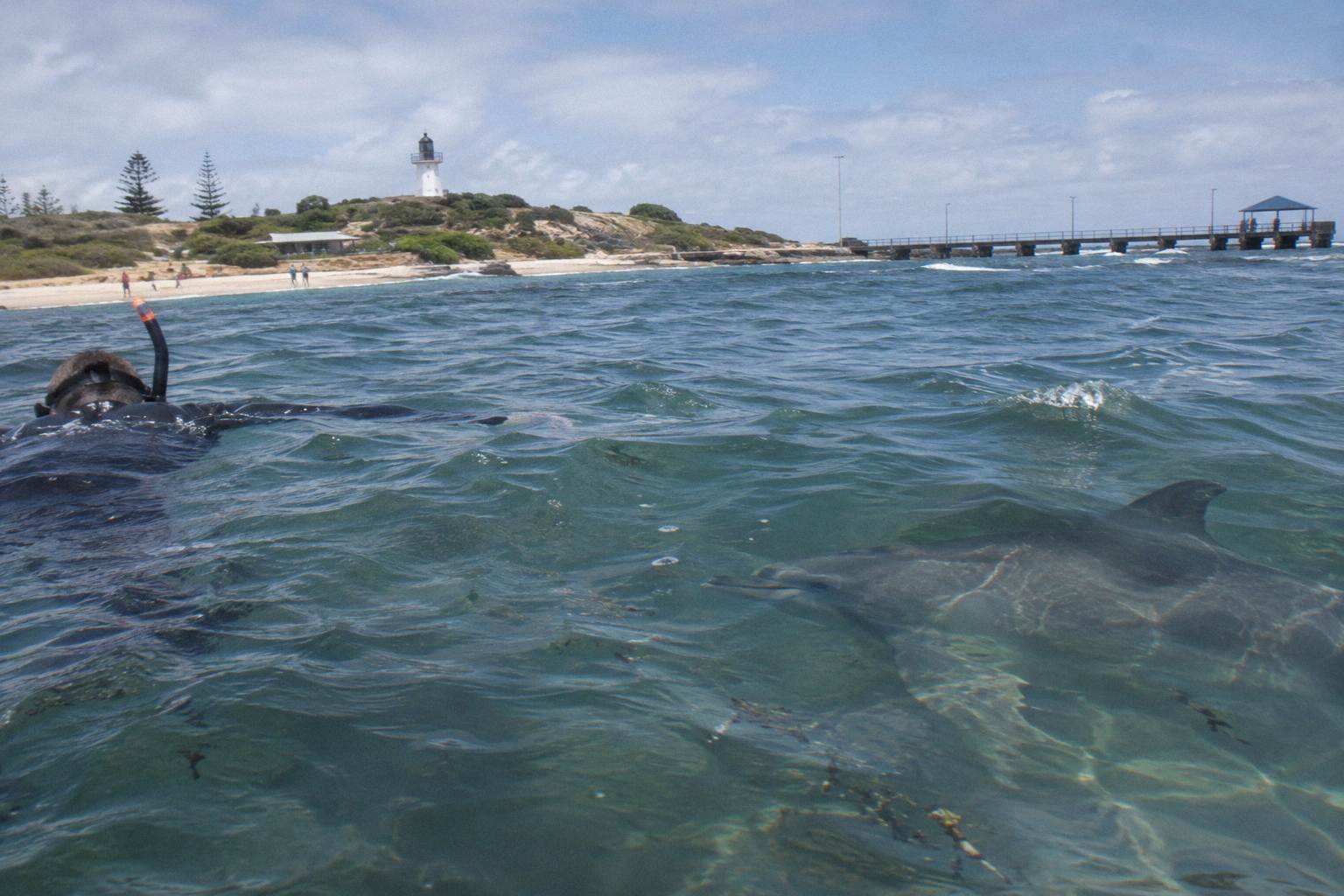
The full separation schedule in Schedule 5 is worth knowing because it shows how deliberately the distances scale. A swimmer keeps 50 m, a vessel keeps 100 m, a non-helicopter aircraft keeps 300 m, a helicopter keeps 500 m, and a drone, called an aerial device in the regulation, keeps 60 m. The consolidated text is published on the legislation.wa.gov.au consolidation of the regulations, and the fines of AUD 5,000 and AUD 10,000 quoted here come from that text.
| Who or what | Separation distance from dolphins | Fine for getting closer | Fine for touching |
|---|---|---|---|
| Person in the water | 50 m | AUD 5,000 | AUD 10,000 |
| Vessel | 100 m | AUD 5,000 | AUD 10,000 |
| Aircraft, not a helicopter | 300 m | not stated separately | AUD 10,000 |
| Helicopter | 500 m | not stated separately | AUD 10,000 |
| Drone, an aerial device | 60 m | not stated separately | AUD 10,000 |
There is one carve-out that explains how a paid swim exists at all. Regulation 112 says the separation rules do not apply to an activity authorised under a licence, and regulation 30 describes the fauna disturbing, commercial interaction licence that covers approaches to fauna for commercial purposes, never feeding. No licence number or licence conditions appear on any operator or official page, so none can be stated, and no named operator is said to hold a named licence. What can be said is that the licensed-swim framework is the reason a guided swim can lawfully operate inside distances that bind everyone else.
That legal frame is also why the question "can you touch them" has a hard answer with a number attached. More on that in whether you can touch wild dolphins when swimming, which works through the AUD 10,000 rule in detail.
Wondering whether the guided format suits you before reading further? Rockingham Swim With Dolphins exists to answer exactly this kind of question.
How The Rockingham Swim Is Structured To Keep Contact Clean
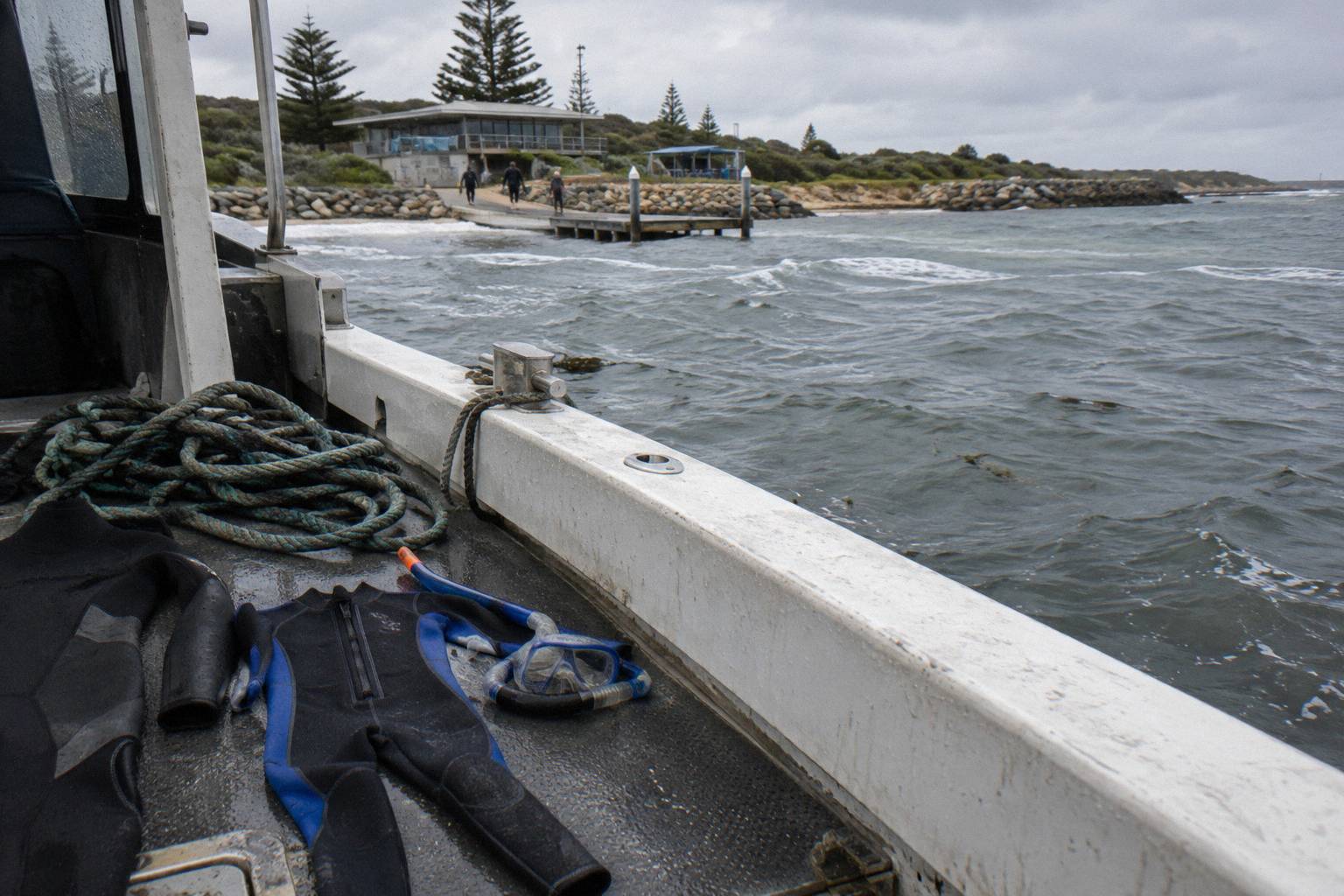
Perth Wildlife Encounters, the operator, describes a format in which every swimmer enters in a group of up to 7 behind a guide on an aqua scooter, holds the guide's belt, stays at the surface, and is told no touching and no feeding, which removes the two behaviours the law penalises most heavily. Once dolphins are located, guests zip up wetsuits, put on mask and snorkel and move to the swim deck. A second lead guide on a solo scooter loops and spins the dolphins close to the group while the first guide tows the swimmers. The operator's own page describes this sequence, and every element of it, the belt, the surface, the guide in front, is a control on what a swimmer's hands and body can do.
The operator says the crew wear Shark Shields, and adds that people with pacemakers or who are pregnant must not use the Shark Shield and should avoid swimming near anyone using one. That is the operator's statement about its own cruise, and it belongs beside the Rockingham swim only. The operator also says the chance of a shark encounter is very low, which is its claim, stated on its page, and no statistic sits behind it on any operator or official page.
For a nervous swimmer, the details that matter are the gentle ones. The wetsuit is 4 mm full length and, in the operator's words, "keeps you very buoyant". No previous snorkelling experience is required, an introductory lesson is part of the kit, and nervous swimmers are accepted. The cruise has no fixed finish time, so the crew keep searching rather than cutting the day short. If your worry is less about dolphins and more about your own confidence, whether non-swimmers can join a wild dolphin swim works through who the format suits.
The full mechanics of the day, from wetsuit to swim deck, are laid out in what happens on a wild dolphin swim day. If the format answers your worry and you want a seat, the Rockingham Wild Dolphin Swim is the tour to look at, listed from A$249.72 per person and varying by date and option, with free cancellation up to 24 hours on the booking page. Check availability
What To Do If A Dolphin Swims Up To You
Regulation 114 gives the answer in law: if a dolphin approaches closer than the separation distance, the swimmer must move away as soon as reasonably possible, and a vessel must go to neutral, switch off, or move away at no more than 6 knots. On a guided swim the guide makes that call for the group, which is one reason the belt-holding format exists: a group that moves as one unit behind a guide can respond immediately. The detailed walkthrough is in what to do if a dolphin swims up to you, including the vessel rules that apply to the boats around you.
The Bunbury swim, run by the Dolphin Discovery Centre in Koombana Bay from November to April, gives the same emphasis from the other operator. Its booking page lists a guided swim of about 4 hours with a wetsuit, mask, snorkel and fins, swimmers must be 8 or over per the operator, and the operator requires independent, confident swimmers. Two operators, two bays, one shared principle: the animal sets the terms and the human follows rules.
If the whole question of proximity makes you uneasy, a watching cruise keeps you at vessel distance, 100 m under the schedule, with no water entry at all. The Mandurah Dolphin Cruise runs 75 minutes of guided spotting with live commentary from a skipper and a local expert, is rated 4.5 across 1,090 reviews, and is listed from A$47 per person with free cancellation up to 24 hours on its booking page.
That page's own wording on its come-again term is worth reading closely: dolphins are wild and choose when and how they interact, so sightings cannot be promised, and if none are sighted you can return free until you see them, rebooking within 12 months, subject to availability. Note the framing of it: the booking page itself says the dolphins decide. Nobody on any of these pages promises an interaction.
Children, Supervision And Who Is Responsible In The Water
The operator of the Rockingham swim says the cruise is not recommended for children 6 years or younger, that parents are responsible for supervising their own children in the water, that staff do not supervise children, and that children are not left on board unsupervised, so supervision is a parental duty, not a crew service. Children's wetsuits come in small sizes, but buoyancy aids are not recommended, and the operator's wording is blunt: if you feel your child needs a buoyancy aid, the cruise is not suitable. At Bunbury the operator sets 8 as the minimum swimming age, with children accompanied by a swimming adult, and allows confident swimmers of 12 or over to swim without one.
The age question deserves its own reading, and how old kids need to be to swim with dolphins covers both operators' rules side by side. If a child in your group is under the stated ages, whether under 7s can watch a dolphin swim from the boat looks at the spectator angle, and the operator of the Rockingham swim says a spectator option exists, with no price stated.
For a family deciding between formats, the arithmetic of supervision matters more than any behaviour question. A guided swim puts a professional in the water with the group, but the responsibility for a child stays with the parent. A watching cruise keeps everyone on the boat, and the Penguin Island And Dolphin Cruise runs about 1 hour 30 minutes from the operator base at 153 Arcadia Drive, Shoalwater, watching only. Its price, rating, inclusions and cancellation terms are not stated, so ask the operator before booking. Planning around the pair of experiences is covered in a Penguin Island and dolphin swim combined day.
What About Sharks On A Dolphin Swim?
Sharks rarely come up around these dolphin swims, at least according to the only operator comment on any page checked: the Rockingham crew wear Shark Shields while in the water, and that operator describes the chance of a shark encounter as very low. No incident figure, no accident statistic and no comparative safety claim appears anywhere in the operator pages, the booking pages or the regulations, and none is invented here. The pacemaker and pregnancy note sits beside the Shark Shield statement on the operator's own page and belongs to this swim only. For the full picture, including the operator's exact wording, see whether it is safe to swim with wild dolphins in Western Australia.
It is worth being precise about what is absent. There is no statement that dolphins keep sharks away, no statement about bite pressure, teeth or dolphin aggression, and no physiological claim of any kind on any operator or official page. A page that answers the bite question with reassurance would have to invent all of that. What exists instead is structure: rules, guides, surface swimming and a legal framework that treats the dolphins' space as theirs.
The ethics angle overlaps here too. The rules that prevent contact are the same rules that protect the animals, and whether swimming with wild dolphins is ethical works through the licence framework from that side. The Murdoch University research behind the region's dolphin science describes four distinct Indo-Pacific bottlenose communities in Perth metro waters, Cockburn Sound, Swan Canning Riverpark, Owen Anchorage and Gage Roads, on its news page on Perth's dolphin communities, a reminder that these are wild animals with their own territories, the operator itself calls the local dolphins territorial and very consistent after more than 25 years' experience with them.
What Trips People Up When They Worry About Being Bitten
The mistake is looking for a statistic that does not exist and then treating its absence as bad news, when every official and operator statement points the other way, at rules that make contact the swimmer's responsibility, not the dolphin's. People assume a guided swim means licence to touch, when the opposite is true: the licence framework covers approach, never feeding, and the AUD 10,000 touching fine stands. People assume the guide supervises their child, when the operator says parents supervise their own children in the water. And people assume the swim's open-ended duration, about 3 to 6 hours as listed, means a long exposure, when the listed wording ties the range to dolphin sightings and the crew's ability to keep searching.
| Assumption | What is actually stated |
|---|---|
| A guided swim allows touching | the licence framework covers approaches to fauna for commercial purposes, never feeding; touching carries a AUD 10,000 fine |
| The crew supervise children in the water | the operator says parents are responsible for supervising their children in the water |
| Someone publishes bite or incident figures | not stated on any operator or official page; ask the operator directly if you want their account |
| The swim has a fixed duration that sets exposure | listed as about 3 to 6 hours depending on dolphin sightings; the operator says cruises have no fixed finish time |
| Reaching out is fine if the dolphin comes to you | regulation 114 says the swimmer must move away as soon as reasonably possible if a dolphin approaches closer than the distance |
A calm alternative for a worried group member is the Mandurah Giants And Dolphin Cruise, 2 hours on a SuperCat with a large open front, upper and lower decks and live commentary, rated 4.8 across 87 reviews and listed from A$85 per person, watching only. The booking page says a fish-and-chip lunch is not included but can be arranged with the operator, soft drinks and light snacks can be bought on board, and free cancellation applies up to 24 hours.
One last practical note on the water itself: the Rockingham operator describes its sea temperature as ranging from 18 degrees Celsius in September to 25 in summer and autumn, and wetsuits with hoods for cooler water are part of the kit. If comfort, not contact, is the real worry, water temperature and wetsuits on a wild dolphin swim has the detail.
Common Questions About Dolphin Bites And Swimmer Safety
Do Dolphins Bite Swimmers?
Not stated. Nothing in the operator pages, the booking pages or the WA regulations mentions bites, and no incident figures exist on any operator or official page. What is stated is a framework that prevents contact: touching marine fauna carries a AUD 10,000 fine, swim groups are guide-led, and swimmers must move away if a dolphin approaches closer than the 50 m separation distance.
Is It Legal To Touch A Dolphin During A Swim?
No. Regulation 118 of the Biodiversity Conservation Regulations 2018 bans touching or attempting to touch any marine fauna, with a AUD 10,000 fine. The licence carve-out in regulation 112 covers authorised approaches for commercial purposes, never feeding, and the Rockingham operator states its own rule the same way: no touching, no feeding.
What Happens If A Dolphin Comes Right Up To Me?
Regulation 114 requires the swimmer to move away as soon as reasonably possible if a dolphin approaches closer than the separation distance, while a vessel must go to neutral, switch off, or move away at no more than 6 knots. On the Rockingham swim the guide leads that response for the group, which is why swimmers hold the guide's belt.
How Close Can A Swimmer Legally Get To Wild Dolphins In WA?
A person in the water must keep 50 m from dolphins under Schedule 5 of the regulations, a vessel 100 m, an aircraft 300 m, a helicopter 500 m and a drone 60 m. Getting closer carries a AUD 5,000 fine for a person or a vessel. Commercial swims operate under a separate framework that authorises approaches for commercial purposes.
Do The Guides Stay In The Water With You?
On the Rockingham Wild Dolphin Swim, yes in a specific sense: the operator says each group of up to 7 is led by a guide on an aqua scooter who tows the group while guests hold the guide's belt and stay at the surface, with a second guide on a solo scooter working around the dolphins. The Bunbury Wild Dolphin Swim is likewise described by its operator as a guided swim.
Can A Nervous Swimmer Still Join?
The Rockingham operator says nervous swimmers are accepted and that no previous snorkelling experience is required, with an introductory lesson included and a 4 mm full-length wetsuit the operator describes as very buoyant. The Bunbury operator requires independent, confident swimmers. Tell the operator your concerns when you book, and raise any medical question with your doctor first.