Can You Touch Wild Dolphins When Swimming?
No. Western Australian law bans touching or trying to touch marine fauna, with a AUD 10,000 fine, and guided dolphin swims operate on a no-touching, no-feeding basis.
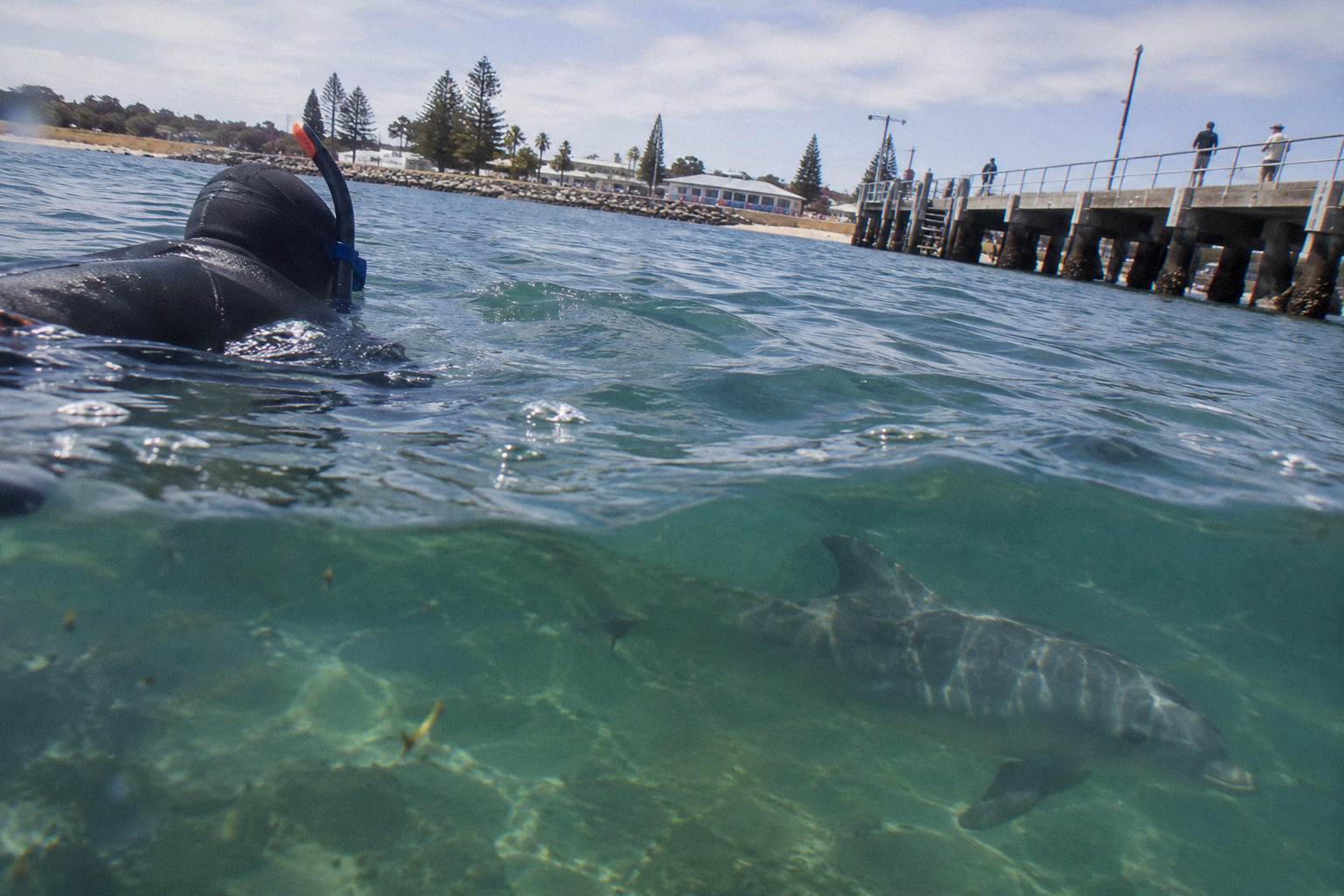
No. In Western Australia it is an offence to touch or attempt to touch any marine fauna, including dolphins, and the fine is AUD 10,000. A person in the water must also stay 50 m from a dolphin unless a licensed activity authorises the approach, and guided swims such as the Rockingham Wild Dolphin Swim are run on the operator's own no-touching, no-feeding terms; if you are weighing it up, Check availability and read the terms before you commit.
No, on two separate grounds. First, state law: under Western Australia's Biodiversity Conservation Regulations 2018, touching or attempting to touch any marine fauna carries a AUD 10,000 fine, and a swimmer must not obstruct the natural movement of marine fauna, a AUD 5,000 offence. Second, the operator's terms: the Rockingham swim is described by its operator as strictly no touching and no feeding, with guests holding a guide's belt while an aqua scooter tows the group among the dolphins.
Those two grounds stack rather than overlap. Even if an operator's rules were somehow relaxed, the law would still apply, and even where a licensed commercial interaction allows a closer approach than the general 50 m distance, the licence framework covers approaches for commercial purposes, never feeding, and nothing in it permits touching. The Murdoch University research on Perth's dolphin communities identifies the species in these waters as the Indo-Pacific bottlenose dolphin, Tursiops aduncus, and that research describes four discrete communities in Perth metro waters: Cockburn Sound, Swan Canning Riverpark, Owen Anchorage and Gage Roads. None of that changes the basic rule for a swimmer: hands off, always.
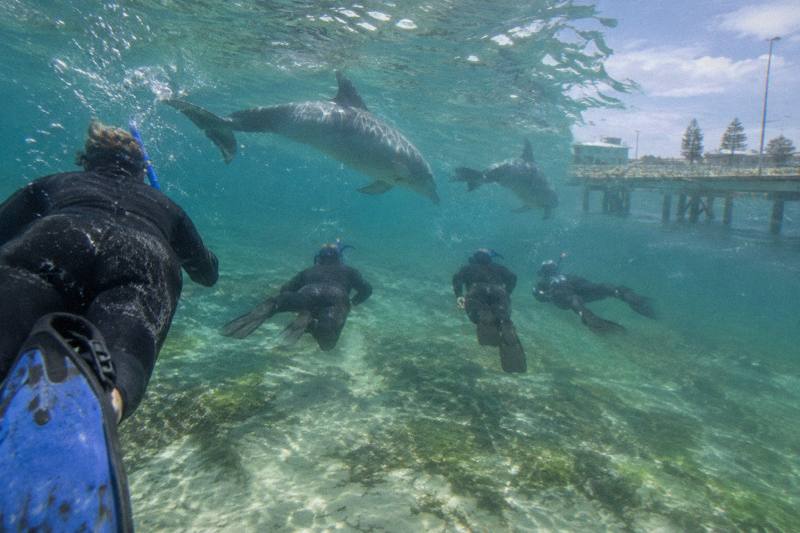
The practical version of a wild dolphin swim is therefore not a petting encounter. It is a surface snorkel in a wetsuit, in a small group, positioned near wild animals that decide for themselves where to go. The operator says guests hold the guide's belt while a second guide on a solo scooter loops and spins the dolphins close to the group. That is the design, and it exists inside a licensing and legal framework that treats the dolphins as protected wild fauna, not as attractions to be handled.
For anyone whose heart was set on contact, the reframing is simple: the swim is sold on proximity and wild behaviour, and the tours that suit different comfort levels are easy to compare.
Two are swims that operate under a no-touching rule, and one is a watching-only cruise from the Shoalwater base at 153 Arcadia Drive, where nobody enters the water at all. The distinction between swimming and watching matters for the touching question in a way many first-time visitors miss: on a watching cruise the touching question never arises, because the dolphins are viewed from the deck.
What WA Law Actually Says About Touching Marine Fauna?
The controlling law is the Biodiversity Conservation Regulations 2018 (WA). Dolphins are "prescribed fauna"; regulation 118 makes it an offence to touch or attempt to touch any marine fauna, with a AUD 10,000 fine; regulation 120 bans obstructing the natural movement of marine fauna in the water, AUD 5,000; and regulation 32 reserves feeding to its own licence. Touching, attempting to touch and feeding are all closed doors.
The regulations are published in full on the WA legislation site, and the consolidated text of the regulations is the source for every distance and penalty figure in this article. It is worth reading the touch ban literally: the offence is not only making contact but attempting to. Reaching out toward a dolphin that passes close, even without contact, sits inside the offence. A swimmer who chases or positions to block a dolphin's path can also fall under the obstruction offence.
One nuance does the opposite of softening the rule. Regulation 112 says the separation-distance rules do not apply to an activity authorised under a licence, and regulation 30 describes the "fauna disturbing (commercial interaction) licence" that authorises approaches to fauna for commercial purposes. That is how a paid swim can lawfully operate closer than 50 m. But the licence framework authorises approaches, not contact and not feeding, and no operator's licence number or licence conditions appear in any official public source here. What is stated plainly: the guided swim is an authorised approach activity, and the touch ban stands regardless.
How Close Can You Get To Wild Dolphins In The Water?
For an unlicensed swimmer, the separation distance for a dolphin is 50 m in the water. A vessel must keep 100 m, a non-helicopter aircraft 300 m, a helicopter 500 m and a drone 60 m. Getting closer than the distance carries a AUD 5,000 fine for a person and the same for a vessel, under regulation 113. A commercial swim needs its own authorisation, which is why tour swimmers can be positioned near dolphins.
The distances are worth seeing side by side, because they are widely misquoted online.
| Party | Separation distance for dolphins | Fine for getting closer |
|---|---|---|
| Person in the water | 50 m | AUD 5,000 |
| Vessel | 100 m | AUD 5,000 |
| Aircraft (not a helicopter) | 300 m | AUD 5,000 |
| Helicopter | 500 m | AUD 5,000 |
| Drone (aerial device) | 60 m | AUD 5,000 |
| Touching or attempting to touch marine fauna | n/a, banned outright | AUD 10,000 |
The fines above are the figures in the regulations, labelled as fines, and the drone figure of 60 m is the one drone operators ask about. A common error in online forums quotes 30 m for swimmers or 10 m for dolphins; neither number appears in the regulations for dolphins. The 10 m figure belongs to sea lions on land in a separate DBCA trial context, which is a different animal and a different rule set.
The 50 m rule also explains why independent swimming toward dolphins is not a lawful alternative to a tour. A swimmer who sees dolphins from a beach and swims out to them is inside the distance rule the moment they close within 50 m, regardless of intent. Commercial tours can approach only because a commercial interaction licence authorises it. For anyone curious about the exact legal boundaries, how close you can legally get to wild dolphins in the water walks through the same regulations from the swimmer's angle.
What Happens If A Dolphin Swims Up To You?
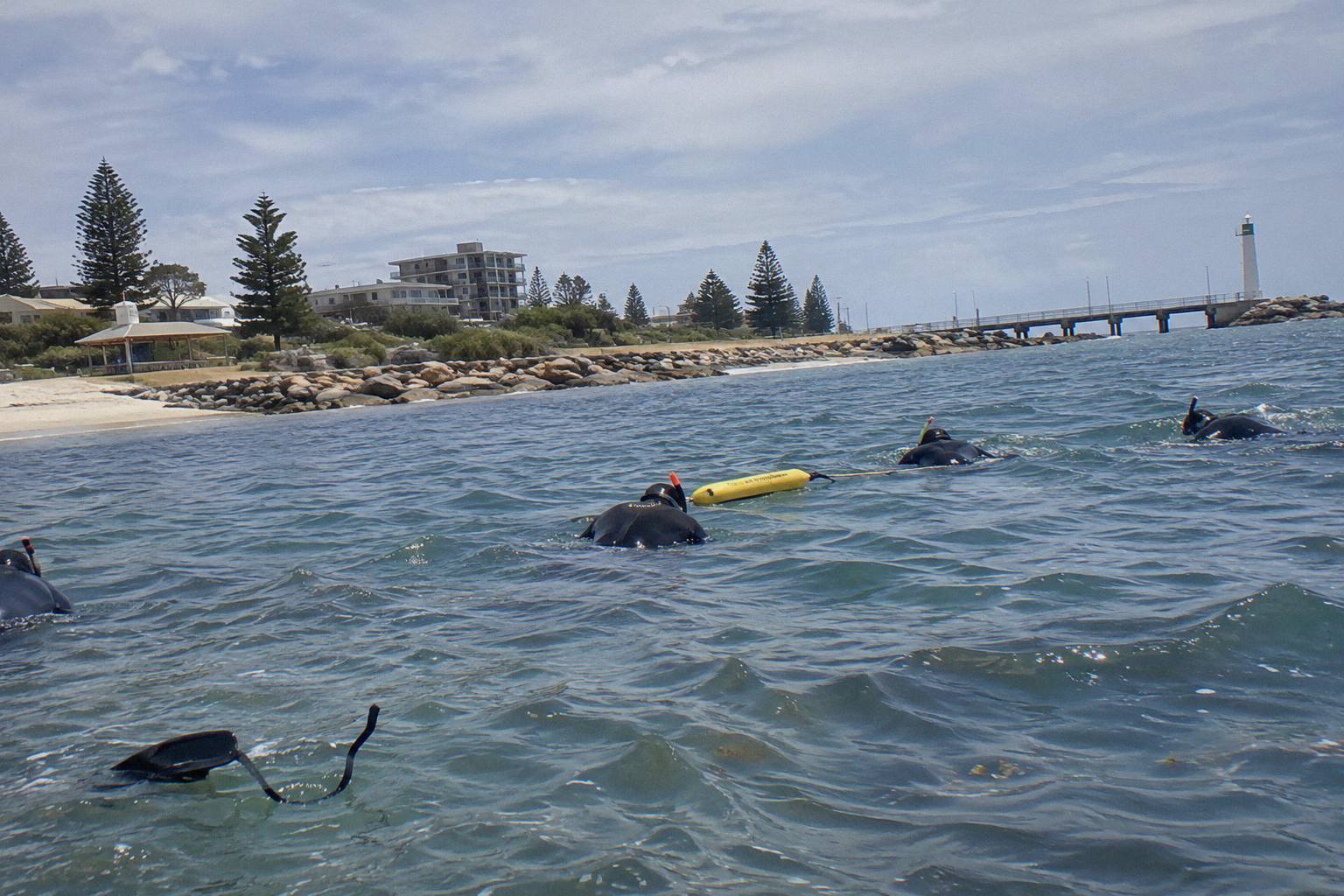
Regulation 114 sets the answer in law: if a dolphin approaches closer than the separation distance, the swimmer must move away as soon as reasonably possible, and a vessel must go to neutral or switch off, or move away at no more than 6 knots. The obligation to act is on the person, not the dolphin. A dolphin closing the distance itself does not create permission to stay put, reach out or touch.
This is the part of the law that surprises people. The rule is not "keep 50 m away" with a loophole for curious animals; it is "do not be the closer party, and if the dolphin is the closer party, withdraw". On a guided swim, the operator's guides manage the group's positioning, and the operator's own description of the swim has guests staying at the surface holding a guide's belt while the dolphins move around the group. The animals' behaviour is theirs to choose; the swimmers' behaviour is regulated and guided.
The same regulation shapes what a swimmer should do in any unplanned encounter, in or out of a tour: stay at the surface, do not reach out, do not chase, and give the animal its line of movement. A vessel operator's parallel duty, going neutral or withdrawing at no more than 6 knots, is why cruise boats behave the way they do when dolphins come near. For a fuller walk-through of an unplanned close approach, what to do if a dolphin swims up to you covers the swimmer's side of regulation 114 in detail.
It also follows that a dolphin choosing to come close is not the same as a dolphin inviting contact. The law draws the line at touching regardless of how the distance was closed, and the obstruction offence in regulation 120 adds a AUD 5,000 exposure for interfering with the animal's natural movement. Reaching out is the single most expensive gesture available to a swimmer in Western Australian waters.
How Does A Guided Swim Work Without Any Touching?
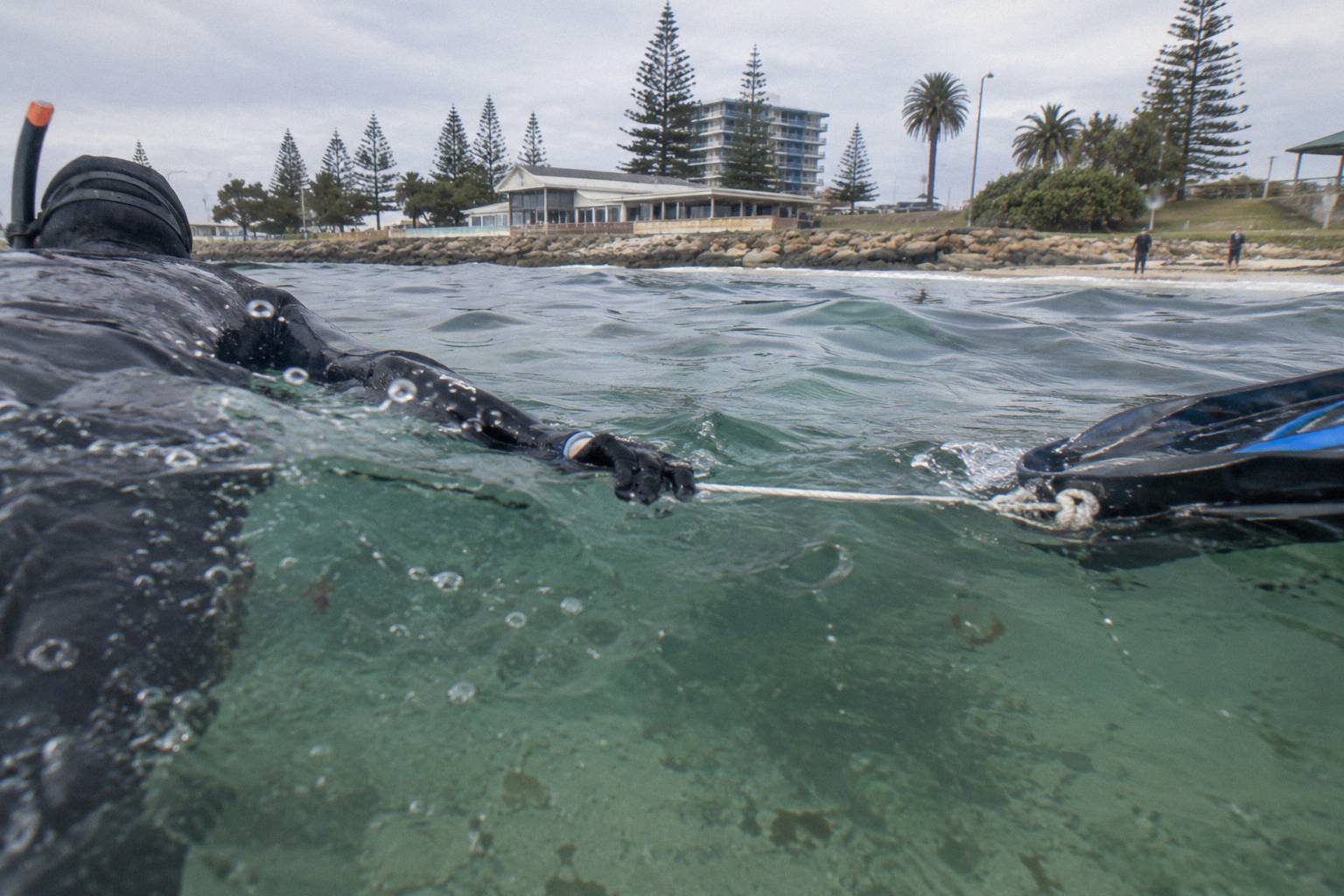
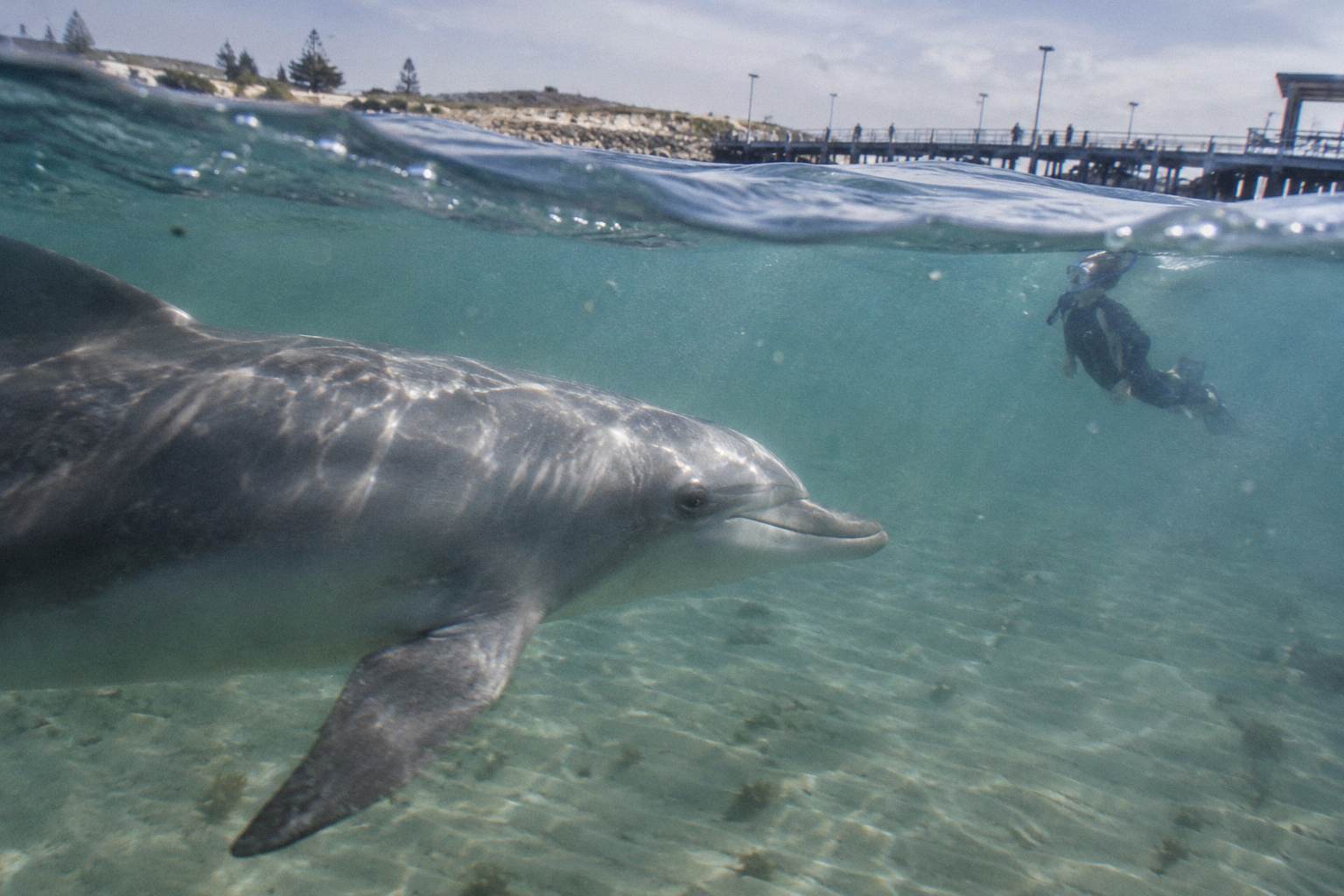
On the Rockingham Wild Dolphin Swim, the operator says entry to the water is in small groups of up to 7, each led by a guide on an aqua scooter who tows the group among the dolphins while guests hold the guide's belt and stay at the surface; a second guide on a solo scooter loops and spins the dolphins close to the group. No touching and no feeding at any point.
The mechanics matter because they answer the natural follow-up question: if you cannot touch them, what is the swim actually like? The operator's description is of a surface experience. Guests wear a 4 mm full-length wetsuit, which the operator says keeps you very buoyant, with mask, snorkel and an introductory snorkel lesson included; no previous snorkelling experience is required and nervous swimmers are accepted. The holding-the-belt format keeps the group together and behind the guide, which is also how the operator keeps the interaction orderly. The Bunbury Wild Dolphin Swim, run by the Dolphin Discovery Centre in Koombana Bay, uses its own format: the operator describes a 4-hour guided swim with wetsuit, mask, snorkel, fins and a buoyancy vest if required, for swimmers 8 and over who are independent, confident swimmers.
The two swims differ in structure as well as location, and the differences are easy to set side by side.
| Feature | Rockingham Wild Dolphin Swim | Bunbury Wild Dolphin Swim |
|---|---|---|
| Operator | Perth Wildlife Encounters | Dolphin Discovery Centre |
| Water entry | Small groups of up to 7, towed by a guide on an aqua scooter, guests hold the guide's belt | Guided swim in Koombana Bay, group of at least 8 and at most 20 swimmers |
| Touching | Not permitted, operator's terms | Not permitted, operator's terms |
| Age guidance | Not recommended for children 6 years or younger, operator | Swimmers 8 and over, operator |
| Kit | 4 mm full-length wetsuit, mask, snorkel, introductory lesson | Wetsuit, mask, snorkel, fins, buoyancy vest if required |
| Season | September to early June, operator | November to April, operator |
| Listed duration | About 3 to 6 hours | About 4 hours |
Neither operator offers contact, and neither could lawfully build a product around it. The Bunbury operator's own page, which describes the swim's inclusions and age rules, frames the experience the same way: guided, structured, no handling. Anyone comparing the two swims can dig into the detail in the Rockingham or Bunbury comparison, which sets out the seasons, ages and formats side by side.
A useful mental model is scuba diving with big marine life elsewhere: the animal decides the encounter, the human holds position and lets it happen. The Rockingham operator lists behaviours its crews have observed, including hunting, mating and sleeping, chasing octopus and squid, and hunting on the back of big stingrays, with a sea lion occasionally joining; those are operator statements about what crews see, not a promise of any behaviour on any given day. The encounter is wild in both the legal and the practical sense.
Which Tours Keep You Out Of The Water Entirely?
Three of the five dolphin tours covered here are watching-only cruises: the Penguin Island And Dolphin Cruise from the Shoalwater base, about 1 hour 30 minutes; the Mandurah Dolphin Cruise, 75 minutes, from A$47 per person; and the Mandurah Giants And Dolphin Cruise, 2 hours, from A$85 per person. On all three, guests stay on the vessel, so the touching question never arises and the 100 m vessel distance is managed by the crew.
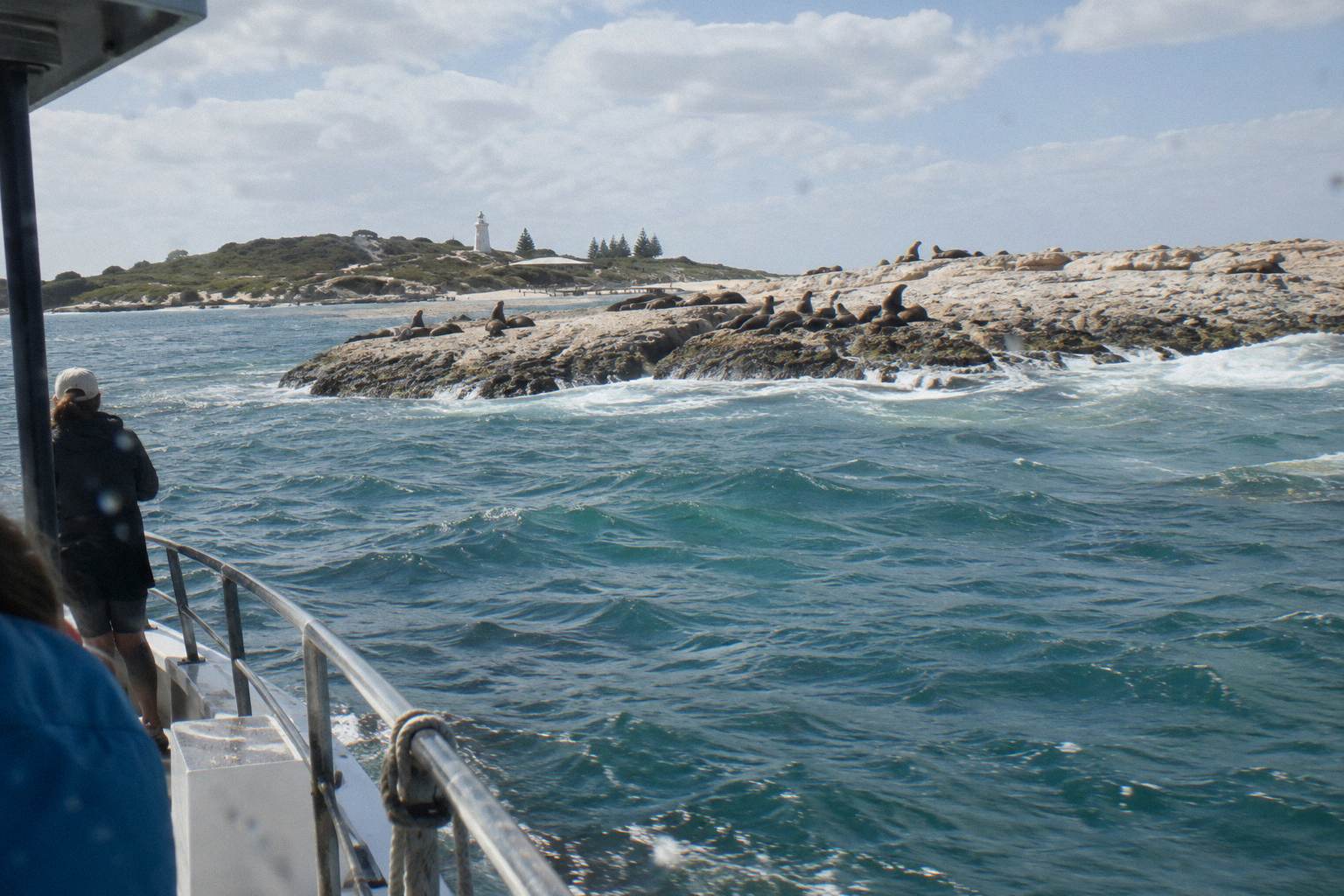
For a traveller who read this far and concluded that a no-contact swim is still more water than they want, the watching format removes the decision entirely. The Mandurah Dolphin Cruise is rated 4.5 across 1,090 reviews and its booking page describes live commentary from a skipper and local expert plus guided dolphin spotting; the Mandurah Giants And Dolphin Cruise, rated 4.8 across 87 reviews, runs a SuperCat with a large open front, upper and lower decks and large windows, and the booking page names a fourth giant sculpture seen from the water. Neither is a swim, and neither is described as one anywhere on its booking page.
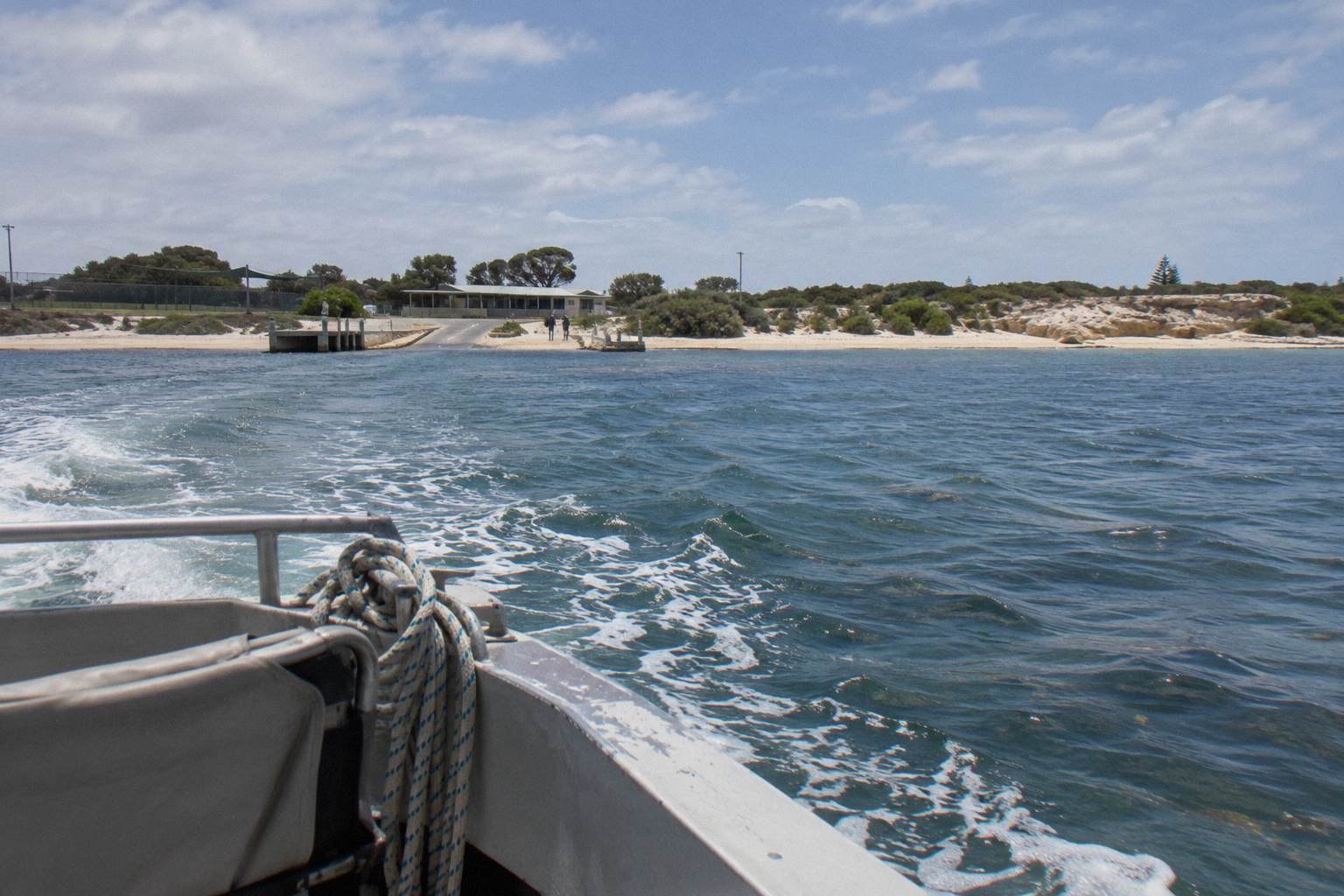
The 87-review pool on the Giants cruise is a small one, and the 1,090 on the Mandurah Dolphin Cruise is the larger sample between the two Mandurah products; both counts are given here exactly as the booking pages give them, without comparison beyond stating them. The Shoalwater Islands Marine Park page on the Parks and Wildlife service site, which describes the park as free to enter and about an hour from Perth, notes wildlife cruises and sea lions on Seal Island among the park's draws. The Penguin Island And Dolphin Cruise meets at 153 Arcadia Drive, Shoalwater, and its price, rating, inclusions and cancellation terms are not stated on its booking page.
A watching cruise is also the natural answer for a mixed group: a nervous swimmer in a party of four can cruise while the others swim, and nobody has to sit out. The trade-offs between the two formats, including how the come-again terms differ between swims and cruises, are laid out in the swim versus watching cruise comparison.
Why The No-Touch Rule Protects The Dolphins, And The Swim?
The regulations exist because repeated close human contact changes wild animals' behaviour, and the licence framework is built to keep commercial dolphin interactions conditional and controlled. Feeding is reserved to a separate licence that commercial interaction tours do not hold, touching is banned outright, and a vessel must move away from visibly disturbed marine fauna under regulation 121. A swim industry that ignored those rules would risk the licence that any lawful commercial swim needs.
The ethics question sits underneath the touching question for many readers, and it has a concrete answer rather than a vague one. The legal architecture, the guide-per-group format and the surface-only design all point the same way: the encounter is structured so the dolphins remain wild animals making their own choices, and Rockingham Swim With Dolphins covers the practical side of booking within that structure. Readers who want the fuller argument, both sides included, can take in whether swimming with wild dolphins is ethical before deciding.
The rule protects swimmers too. Wild dolphins are large, fast animals, and the law's requirement that a swimmer withdraw when a dolphin approaches close removes any ambiguity about who moves. On the Rockingham swim the crew wear Shark Shields, and the operator says people with pacemakers or who are pregnant must not use the Shark Shield and should avoid swimming near anyone using one; suitability questions like those go to the operator at booking time, alongside any medical advice a doctor has given. The broader safety picture, still inside the stated rules, is set out in whether it is safe to swim with wild dolphins in Western Australia.
What Trips People Up About Touching Wild Dolphins?
The most common mistake is assuming the tour operator's permission and the law are the same thing, when the touch ban applies regardless of any ticket. The second is quoting the wrong distance: 30 m and 10 m circulate online for dolphin swimmers, but the regulation says 50 m for a person in the water. The third is assuming a dolphin that approaches close has invited contact; regulation 114 requires the swimmer to move away.
A short checklist of the exact traps:
- Treating a guided swim as a contact swim. The licence authorises the approach, not touching, and the Rockingham operator's own terms say no touching and no feeding.
- Mixing up the numbers. 50 m swimmer, 100 m vessel, 300 m aircraft, 500 m helicopter, 60 m drone; the 10 m figure belongs to sea lions on land in a separate trial, not to dolphins.
- Thinking a come-again term is a refund. The Rockingham operator's come-again offer, for bookings made direct with the operator, is a free return, not cash back, and it is that operator's term only; the booking page separately shows free cancellation up to 24 hours. The interplay is untangled in the refund and no-show explainer.
- Expecting to feed or lure dolphins. Feeding needs its own licence under regulation 32, and no tour here holds or offers it.
- Assuming drone footage is fine. Drones must stay 60 m from dolphins under Schedule 5.
The thread connecting all five is the same: the swim is an authorised approach to protected wild fauna, and every rule bends toward the animal's autonomy. Readers who want the practical pre-booking version of this list will find it in the first-timer's checklist for a wild dolphin swim.
Common Questions About Touching Wild Dolphins
Can You Touch Wild Dolphins When Swimming?
No. Touching or attempting to touch any marine fauna in Western Australia carries a AUD 10,000 fine under regulation 118 of the Biodiversity Conservation Regulations 2018, and guided swims such as the Rockingham Wild Dolphin Swim are run on the operator's own no-touching, no-feeding terms, with guests holding a guide's belt rather than the animals.
What Is The Fine For Touching A Wild Dolphin In WA?
The regulations state a AUD 10,000 fine for touching or attempting to touch marine fauna. Obstructing or interfering with the natural movement of marine fauna in the water carries a AUD 5,000 fine, and getting closer than the separation distance carries AUD 5,000 for a person and the same for a vessel.
Can A Guided Dolphin Swim Legally Touch Dolphins?
No. A commercial interaction licence authorises approaches to fauna for commercial purposes under regulation 30; it never covers feeding, and the touch ban in regulation 118 applies regardless of any licence. The Rockingham operator's terms state no touching and no feeding on its swims.
What If A Dolphin Comes Right Up To You?
Regulation 114 requires the swimmer to move away as soon as reasonably possible when a dolphin approaches closer than the separation distance, and a vessel must go to neutral or switch off, or move away at no more than 6 knots. The dolphin closing the distance does not permit staying put or reaching out.
How Close Can You Swim To Wild Dolphins Without A Tour?
50 m is the separation distance for a person in the water. Swimming closer than that as an unlicensed member of the public carries a AUD 5,000 fine. A commercial interaction licence is what allows commercial tour groups to be positioned near dolphins.
Are There Dolphin Tours Where You Stay Out Of The Water?
Yes. The Penguin Island And Dolphin Cruise, about 1 hour 30 minutes from the Shoalwater base; the Mandurah Dolphin Cruise, 75 minutes from A$47 per person; and the Mandurah Giants And Dolphin Cruise, 2 hours from A$85 per person, are all watching-only. Guests stay on the vessel and no swimming is involved.