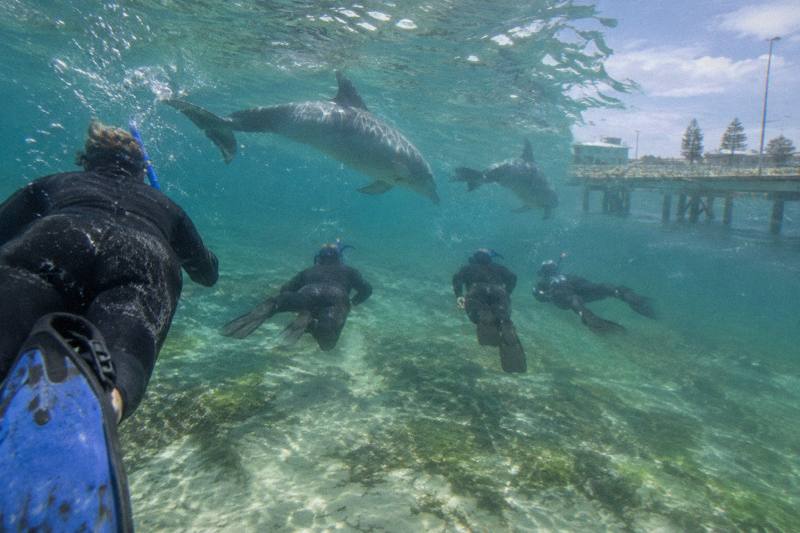
What Do Wild Dolphins Actually Do Around Swimmers Near Perth?
What wild dolphins actually do around swimmers on a guided Rockingham dolphin swim: the operator's own description of the encounter, the behaviours observed, and the WA rules that shape it.
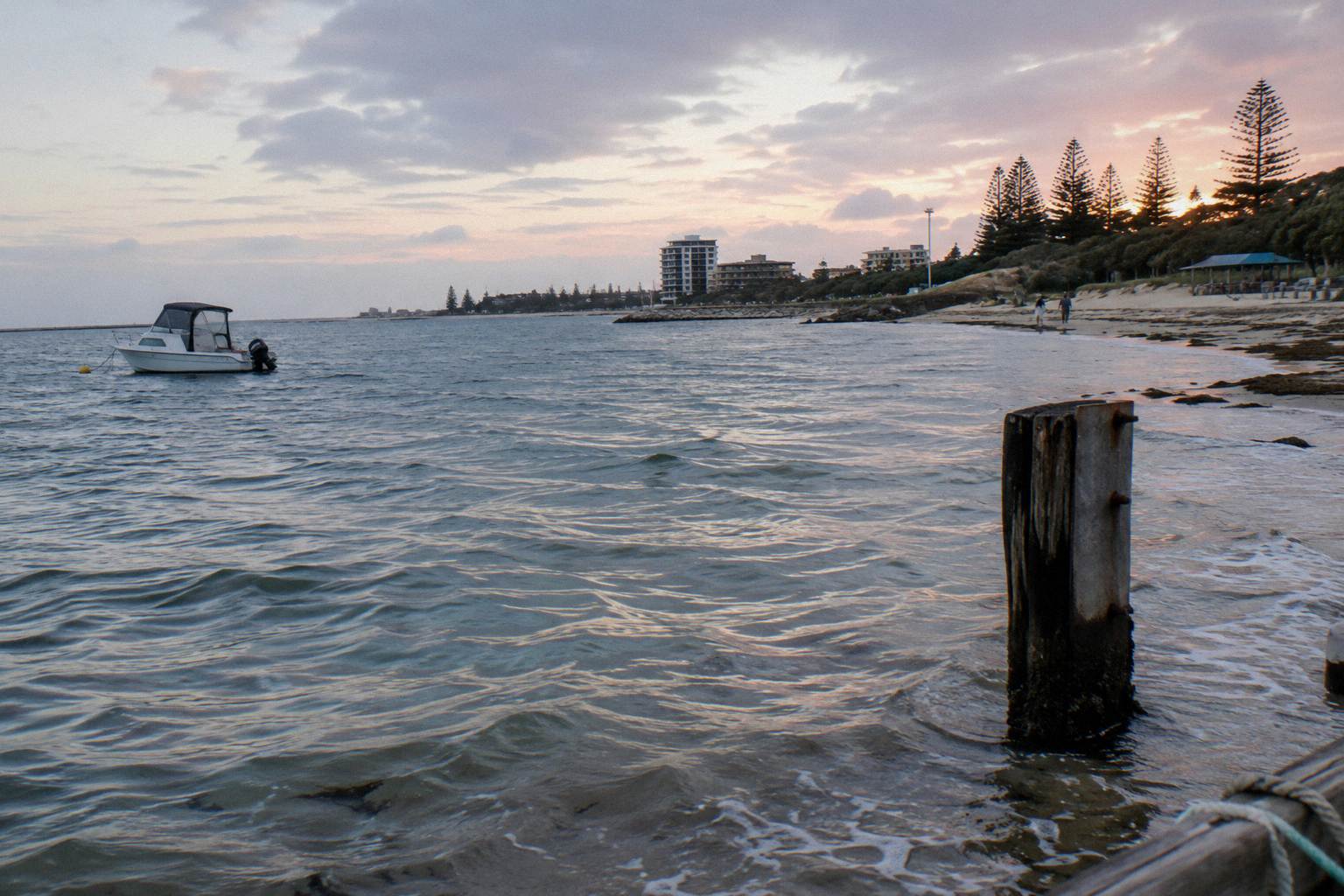
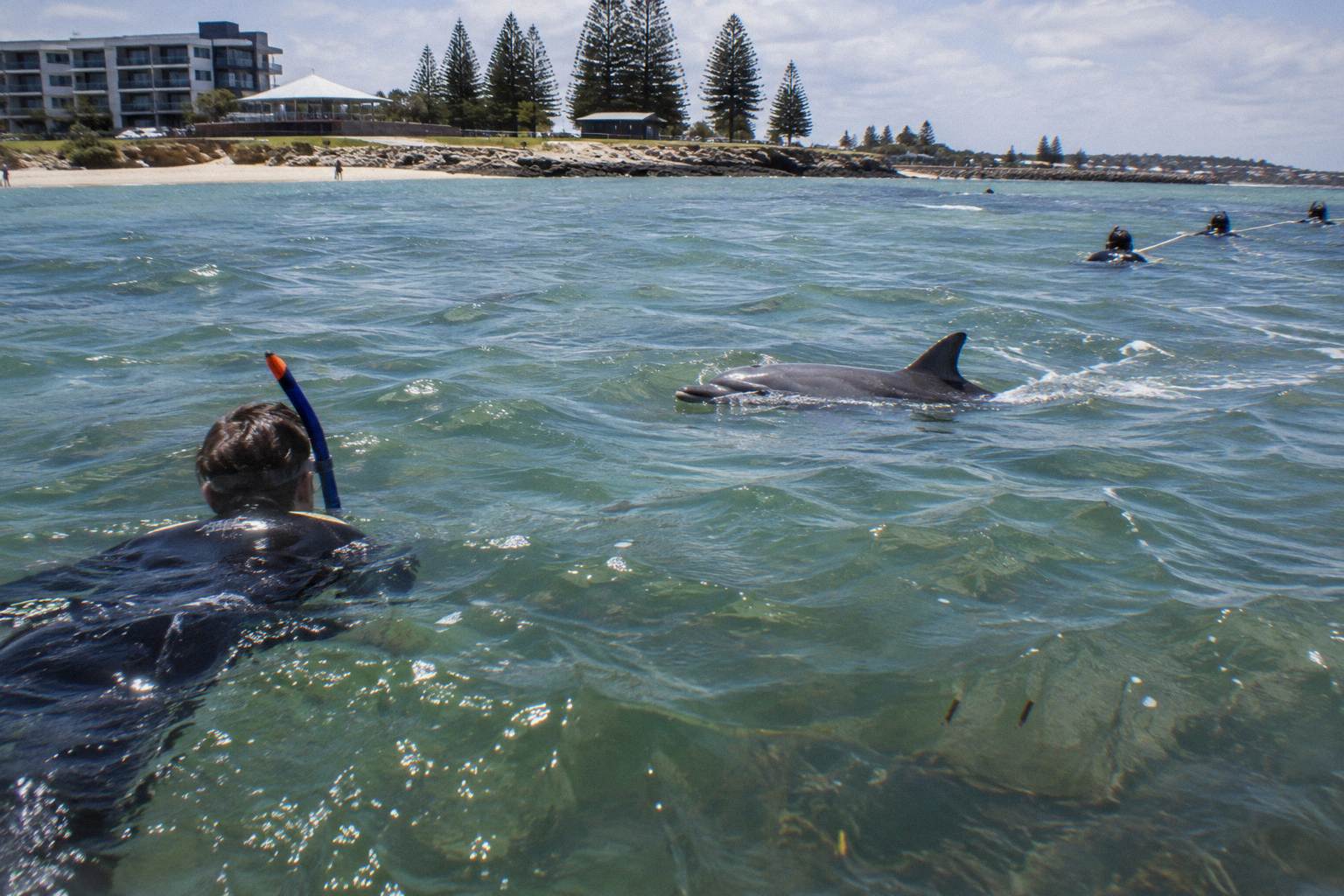
Wild dolphins are not trained animals, and nothing about a guided swim makes them perform. On the Rockingham Wild Dolphin Swim, the operator says groups of up to 7 swimmers hold a guide's belt and are towed on an aqua scooter among dolphins that are hunting, mating, sleeping, chasing octopus and squid, or hunting on the back of big stingrays, and that a sea lion occasionally joins. What any given swim looks like depends on what those wild animals are doing that day, which is exactly why the cruise has no fixed finish time. This article sets out what the operator and the regulations actually state, and nothing beyond it.
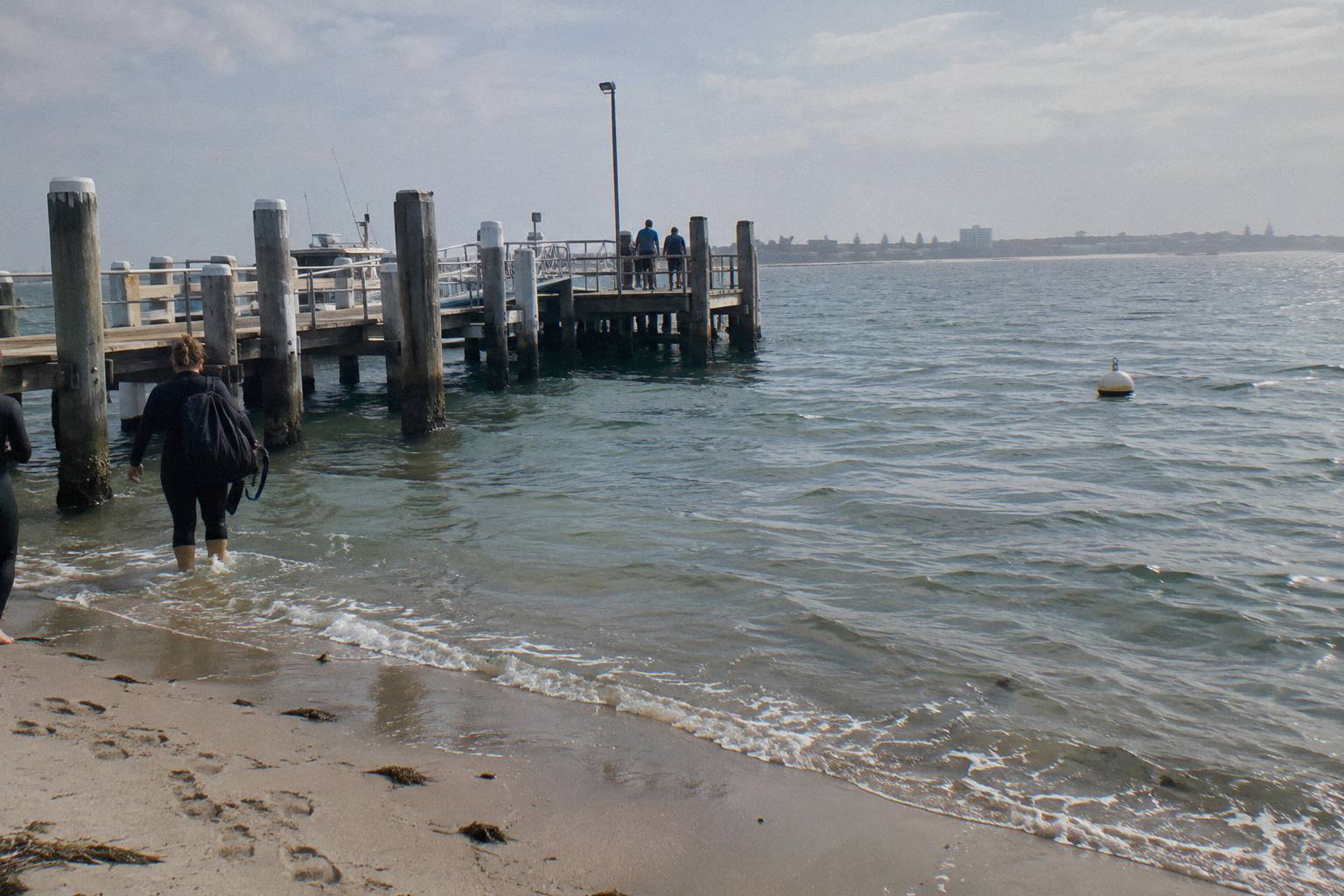
Around Rockingham, near Perth, the swim operator's crews report seeing wild dolphins hunt, mate, sleep, chase octopus and squid, and hunt on the back of big stingrays, with a sea lion occasionally joining in. Swimmers simply drift at the surface while the dolphins carry on whatever they were already doing, since these are wild animals and no behaviour is promised on any particular day.
That last sentence deserves care. The looping guide is part of the operator's described method: the lead guide tows the swim group while a second guide on another scooter moves the dolphins past the swimmers. The dolphins themselves remain wild animals making their own choices, and WA law, set out in the Biodiversity Conservation Regulations 2018, treats them as prescribed fauna with strict separation distances and a total ban on touching.
So the frame for the question is threefold. First, what the operator says happens on its own cruises. Second, what the research says about which dolphins live in Perth waters. Third, what the law allows a guided swim to do that a solo swimmer may not. Those three strands together describe the encounter far better than any story about a friendly individual animal, and none of the sources names a single dolphin or tells a tale about one.
For a reader weighing whether to book, the practical takeaway is that the encounter is a surface-level drift among actively living animals: the operator says guests stay at the surface, hold a guide's belt, and are moved among dolphins that may be mid-hunt or mid-rest. The first-timers checklist for a wild dolphin swim covers the practical side of preparing for exactly that kind of experience.
How The Rockingham Swim Puts You In The Water
Once the dolphins are located, you zip up your wetsuit, put on mask and snorkel, and move to the swim deck, then enter the water in small groups of up to 7. Each group is led by a guide on an aqua scooter; you hold the guide's belt and stay at the surface as the guide tows you among the dolphins.
The tow changes what the encounter feels like in a way worth understanding before booking. A swimmer hanging onto a guide's belt is not chasing dolphins under their own power; the scooter does the work of closing the distance, and the swimmer's job is to hold position at the surface and watch. The operator says no previous snorkelling experience is required and that nervous swimmers are accepted, which fits a format where propulsion, navigation and decisions all rest with the crew.
The kit supports the same idea. The operator provides a 4 mm full-length wetsuit it describes as keeping you very buoyant, plus mask, snorkel and an introductory snorkel lesson, with children's wetsuits in small sizes. Buoyancy aids are not recommended, and the operator says plainly that if you feel your child needs one, the cruise is not suitable. Parents supervise their own children in the water, staff do not supervise children, and children are not left on board unsupervised. The operator also says the swim is not recommended for children 6 years or younger.
Two crew safety points come from the operator directly. The crew wear Shark Shields, and the operator says people with pacemakers or who are pregnant must not use the Shark Shield and should avoid swimming near anyone using one. And the cruise has no fixed finish time, so the crew can keep searching: a booking page describes the day as approximately 3 to 6 hours depending on dolphin sightings. If your question is less about swimming and more about watching, the guide comparing a swim with a watching cruise works through that choice.
Anyone drawn by this description can look at the Rockingham Wild Dolphin Swim directly, from A$249.72 per person, rated 4.7 across about 685 reviews, with free cancellation up to 24 hours on the booking page: Check availability. The season runs September to early June, and what swimmers should wear underneath the wetsuit is not stated, so ask the operator when booking.
What The Operator Says Dolphins Do Around The Boat
The operator's own page lists six observed behaviours: hunting, mating, sleeping, chasing octopus and squid, hunting on the back of big stingrays, and, occasionally, a sea lion joining. Each is an operator statement about the waters it works, and none is a schedule or a promise. What the operator adds about the dolphins themselves is that it has over 25 years of experience with them and calls them territorial and very consistent, its own characterisation rather than a scientific finding.
It helps to sort those behaviours by what they mean for a swimmer. Hunting and sleeping sit at opposite ends: an animal chasing squid is moving fast and changing direction, while a resting group surfaces quietly and keeps a steady line. Mating is energetic and social. None of that is staged, and the operator's no-touching, no-feeding rule keeps it that way. Touching or attempting to touch any marine fauna carries a AUD 10,000 fine under the regulations, a point covered in full further down.
| Behaviour the operator lists | What the operator's wording suggests about the scene | Stated by |
|---|---|---|
| Hunting | Active pursuit of prey, fast movement | Operator page |
| Mating | Energetic social interaction between dolphins | Operator page |
| Sleeping | Quiet, steady surfacing | Operator page |
| Chasing octopus and squid | Pursuit of specific prey near the bottom or in weed | Operator page |
| Hunting on the back of big stingrays | Dolphins following stingrays to feed on what they disturb | Operator page |
| A sea lion occasionally joins | Another marine mammal present near the group | Operator page |
The second guide's role belongs in the same picture. The operator says a lead guide on a solo scooter loops and spins the dolphins close to the group, which is the mechanical answer to how wild animals end up near swimmers at all: the crew position the swimmers where the dolphins are, and the dolphins decide the rest. That division of labour, crew effort plus animal choice, is the core of every guided wild dolphin swim in WA.
It is also why the operator's phrase "within inches" appears in its description while a swimmer's own experience may feel varied. The operator reports what its method produces across a season; no source states what any single swim produces. A related question many readers hold is answered separately in what dolphins are in Western Australia, which covers the species side rather than the behaviour side.
For travellers who would rather watch these behaviours from a deck than from the water, the Mandurah Dolphin Cruise is a 75-minute watching cruise from A$47 per person, rated 4.5 across 1,090 reviews, with live commentary from a skipper and a local expert and free cancellation up to 24 hours on the booking page.
The Rules That Shape The Encounter
Western Australian law sets a 50 m separation distance for a person in the water and 100 m for a vessel, with AUD 5,000 fines for getting closer and a AUD 10,000 fine for touching or attempting to touch any marine fauna; however, the distance rules do not apply to activities authorised under a licence, making a paid dolphin swim lawful, though no licence number or conditions appear in official sources.
The distances matter to anyone imagining a do-it-yourself version. If a dolphin approaches a swimmer closer than 50 m, regulation 114 requires the swimmer to move away as soon as reasonably possible, and a vessel must go neutral or move away at no more than 6 knots. A person in the water must not obstruct or interfere with the natural movement of marine fauna, which carries a AUD 5,000 fine, and feeding needs its own licence. "Diving" with marine fauna, meaning swimming with an artificial air supply, is banned, so scuba is out and snorkelling at the surface is the format. Everything else covered here is indexed on Rockingham Swim With Dolphins.
| Rule | Distance or penalty | Source |
|---|---|---|
| Person in the water near a dolphin | 50 m | Biodiversity Conservation Regulations 2018, Schedule 5 |
| Vessel near a dolphin | 100 m | Biodiversity Conservation Regulations 2018, Schedule 5 |
| Aircraft, not a helicopter | 300 m | Biodiversity Conservation Regulations 2018, Schedule 5 |
| Helicopter | 500 m | Biodiversity Conservation Regulations 2018, Schedule 5 |
| Drone, an aerial device | 60 m | Biodiversity Conservation Regulations 2018, Schedule 5 |
| Closer than the separation distance | AUD 5,000 fine, person or vessel | Regulation 113 |
| Touching or attempting to touch marine fauna | AUD 10,000 fine | Regulation 118 |
The licence exception is the piece most first-page explanations miss. Regulation 112 exempts an activity authorised under a licence from the distance division, and regulation 30 defines the fauna disturbing, commercial interaction licence that covers approaches to fauna for commercial purposes, never feeding. That is the legal architecture behind the tow-and-guide format described above, and it is why a guided swim can close distance that an unlicensed swimmer legally cannot. How close you can get in the water, legally and in practice, is unpacked in how close you can get to wild dolphins.
One adjacent fact needs careful framing. DBCA approved a licensed trial for swimming with sea lions on the coastline, and the department's announcement names Perth Wildlife Encounters as the one Shoalwater Islands Marine Park operator chosen for it. That trial is about sea lions, not dolphins, and nothing in any source here says the dolphin swim includes sea lion swimming, so never book a dolphin swim expecting it.
Which Dolphins Live Near Rockingham
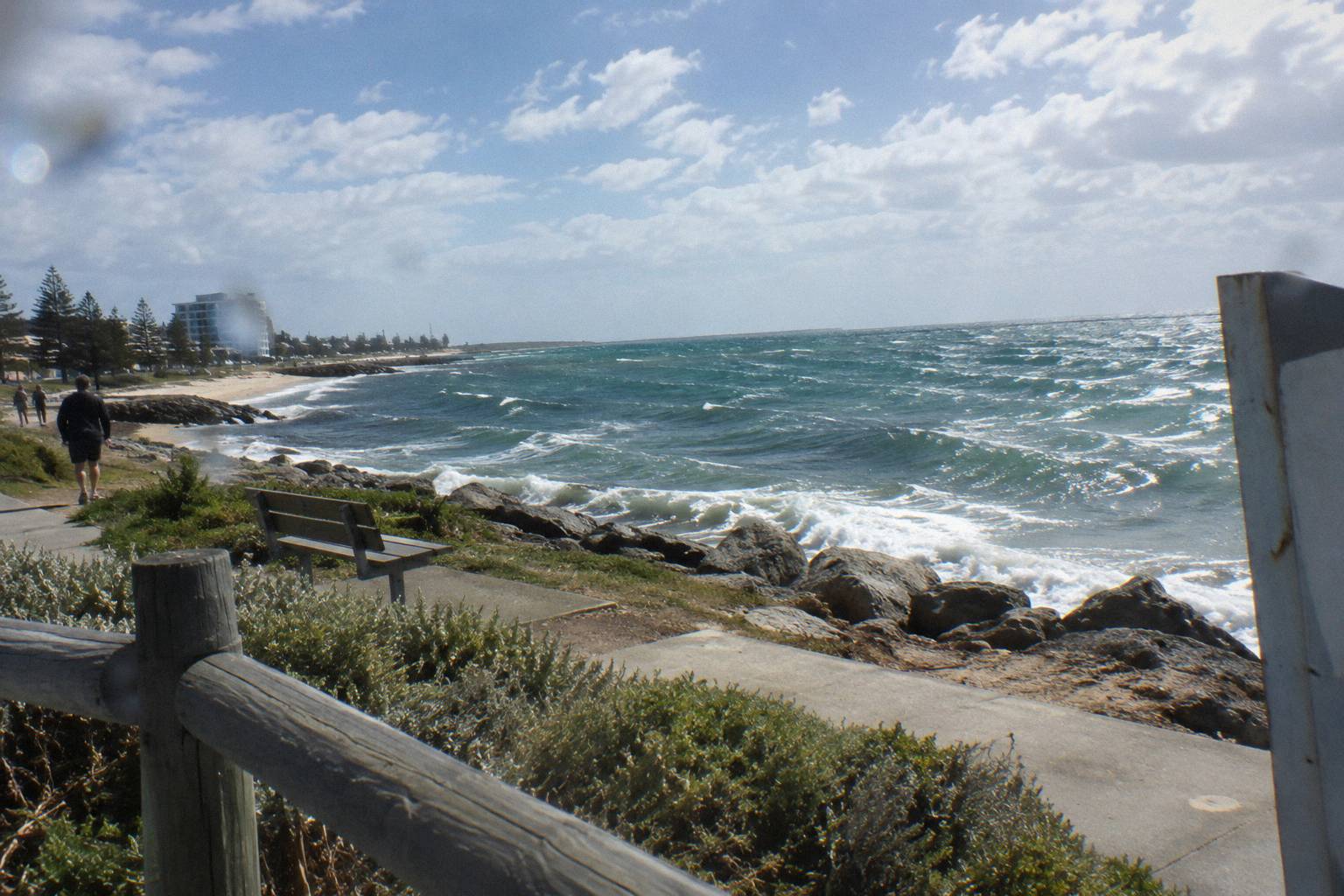
Murdoch University research identified four discrete Indo-Pacific bottlenose dolphin communities in Perth metro waters: Cockburn Sound, the Swan Canning Riverpark, Owen Anchorage and Gage Roads. The species is Tursiops aduncus, the Indo-Pacific bottlenose dolphin. Rockingham's Shoalwater side sits beside Cockburn Sound, but no source states that the dolphins on the Rockingham swim are the Cockburn Sound community, so that link cannot be claimed.
The research matters for expectations. Four separate communities means the dolphins off Rockingham are not the same animals seen off Perth's city beaches, and each community moves within its own area. The Murdoch University summary of the study, led by Dr Delphine Chabanne and published in Frontiers in Marine Science, is the primary source for that finding, and it is the reason this article prints no dolphin count for Rockingham: no official abundance figure for these waters appears in any source here.
A count does exist for one other place, and only there. The Dolphin Discovery Centre says its Koombana Bay group in Bunbury averages about 50 animals, with 100 or more visiting through the year, a statement from the Centre's own research page about Bunbury and never about Rockingham. The Bunbury Wild Dolphin Swim, run by the Centre, is about 4 hours in Koombana Bay, swimmers must be 8 or over by the operator's rule, and its booking page shows free cancellation up to 24 hours; its price is on the booking page rather than stated as a figure here.
For behaviour questions, the community structure is the quiet insight: a territorial and very consistent local population, in the operator's words, combined with four genetically distinct communities across Perth waters, means the dolphins around a Rockingham swim group are animals that live there, not pass-through visitors from somewhere else. That distinction shapes how the swim works and why the operator can search the same grounds across a season from September to early June.
Watching From The Boat Instead Of Swimming
Yes, you can watch from the boat: three of the five tours covered here are watching only, with no swimmer in the water, namely the Penguin Island And Dolphin Cruise, the Mandurah Dolphin Cruise, and the Mandurah Giants And Dolphin Cruise. Watching suits a group that includes a non-swimmer, a child under the operator's swim ages, or anyone who wants the behaviours from the operator's list without the wetsuit.
The two formats answer the same curiosity differently. A swim places you at surface level among whatever the dolphins are doing, in groups of up to 7 towed by a guide. A cruise keeps you on deck, further from the animals, with commentary interpreting what the group is doing. Neither promises a sighting, and the booking page for the Mandurah Dolphin Cruise says in its own words that dolphins are wild and choose when and how they interact, so sightings cannot be promised, and that if none are sighted you can return free until you see them, rebooking within 12 months, subject to availability.
| Tour | Format | Duration | Price | Rating and reviews |
|---|---|---|---|---|
| Rockingham Wild Dolphin Swim | Swim, groups of up to 7 towed by a guide | about 3 to 6 hours | from A$249.72 | 4.7, about 685 reviews |
| Bunbury Wild Dolphin Swim | Swim, Koombana Bay | about 4 hours | on the booking page | 4.7, 24 reviews |
| Penguin Island And Dolphin Cruise | Watching only | about 1 hour 30 minutes | Not stated | Not stated |
| Mandurah Dolphin Cruise | Watching only | 75 minutes | from A$47 | 4.5, 1,090 reviews |
| Mandurah Giants And Dolphin Cruise | Watching only | 2 hours | from A$85 | 4.8, 87 reviews |
A mixed group can split sensibly across these options. The operator of the Rockingham swim says a spectator option exists, with no price stated, so a non-swimming partner can ride along while the swimmer takes to the water, and the question of whether younger children can watch from the boat is covered in whether under 7s can watch a dolphin swim. At Bunbury, the operator's own terms for direct bookings allow non-swimmers to sit on the boat, though the Centre states no refund for that, a term that belongs to the Centre's direct bookings alone.
The Mandurah Giants And Dolphin Cruise adds a different layer to a watching day: the booking page describes a SuperCat with upper and lower decks, live commentary, a free return if dolphins are not sighted, snacks and soft drinks for sale on board, and a giant sculpture seen from the water. Free cancellation up to 24 hours applies on the booking page, and a fish-and-chip lunch is not included but can be arranged by contacting the operator.
What Trips People Up When Expecting A Performance
The main mistakes are treating the operator's behaviour list as a promised menu, forgetting that wild dolphins hunt, rest and mate on their own schedule, assuming the licence exception permits contact despite the AUD 10,000 fine for touching, and expecting tricks or a swimming test when the swimmer's only jobs are holding a belt and staying at the surface.
A few specifics are worth naming. The wetsuit, not your own swimming strength, does the floating: the operator says the 4 mm suit keeps you very buoyant, and buoyancy aids are not recommended, to the point that a child who needs one is told the cruise is unsuitable. The waiver signed before boarding is standard, not a warning sign, but it deserves an actual read. And the 3 to 6 hour range is a search window, not a programme of activities: the booking page's own wording ties the length to dolphin sightings.
Questions worth asking the operator before booking, all drawn from what the sources do and do not state: what food and drink is available on board, since that is not stated for the Rockingham swim; what pickup arrangements exist for your booking channel, since the operator offers a Perth CBD bus transfer at extra cost for direct bookings only and the booking page states nothing; whether the spectator option suits your group and what it costs; and what the crew advise for swimmers with pacemakers or who are pregnant, given the operator's Shark Shield rule. Asking beats assuming on every one of those.
Finally, expect the water to be part of the experience. The operator says sea temperatures run from 18 in September to 25 degrees Celsius in summer and autumn, and seatemperature.org averages for the Mandurah coast run from 18.3 in September to 22.8 in March, so the wetsuit is doing real work outside midsummer. Anyone weighing the whole question of ethics can take it further in whether swimming with wild dolphins is ethical, which is a fair question to hold alongside this one.
Common Questions About Wild Dolphins Around Swimmers
What Do Wild Dolphins Actually Do Around Swimmers?
The operator of the Rockingham swim lists hunting, mating, sleeping, chasing octopus and squid, hunting on the back of big stingrays, and occasionally a sea lion joining, all as operator-observed behaviour. Swimmers stay at the surface in groups of up to 7, towed by a guide on an aqua scooter, and what happens on any day depends on the dolphins.
Do The Dolphins Come Close To The Swimmers?
The operator says a second guide on a solo scooter loops and spins the dolphins close to the group, and its description includes the phrase "within inches". That is the operator's account of its method across its cruises, not a promise about a particular swim.
Can You Touch The Dolphins During A Swim?
No. The operator prohibits touching and feeding, and touching or attempting to touch any marine fauna carries a AUD 10,000 fine under the Biodiversity Conservation Regulations 2018. A person in the water must not obstruct the natural movement of marine fauna either, which carries a AUD 5,000 fine.
Why Can A Guided Swim Get Closer Than 50 M?
Regulation 112 of the Biodiversity Conservation Regulations 2018 exempts an activity authorised under a licence from the separation-distance division, and regulation 30 defines the commercial interaction licence covering approaches to fauna. The 50 m rule for a swimmer applies to everyone not operating under such an authority.
Do The Same Dolphins Come Back Every Swim?
The operator describes the local dolphins as territorial and very consistent, and says it has over 25 years of experience with them. Murdoch University research identifies distinct Indo-Pacific bottlenose communities in Perth waters, which supports the idea of local animals rather than passing ones, but no source names individual dolphins or their movements.
What If No Dolphins Interact With The Swimmers?
Nothing is promised. The Rockingham operator's own term for direct bookings is that if no dolphins are seen or swum with, you are welcome to come again free of charge, rebooking within the season, subject to availability, and the booking page shows free cancellation up to 24 hours. Each term belongs to its own channel and neither is a cash refund for a no-show on the day.